Please turn on JavaScript

Brooks Wilson's Economics Blog: Recession
Showing posts with label Recession. Show all posts

Saturday, July 11, 2009

Biden on the Economic Recession

Scott Wilson, writing for the Washington Post in "Biden Acknowledges Administration 'Misread' The Economy," writes

Vice President Biden acknowledged today that the administration underestimated the depth of the economic recession months ago as it prepared a recovery package that is only now beginning to take effect.

"We misread how bad the economy was, but we are now only about 120 days into the recovery package," Biden said on ABC's "This Week." "The truth of the matter was, no one anticipated, no one expected that that recovery package would in fact be in a position at this point of having distributed the bulk of the money."

I read with incredulity. The administration underestimated the depth of the recession? Every news source from newspapers to radio and television to the blogosphere seemed full of economists stating that the economic crisis was the worst since the Great Depression. Democrats everywhere based their campaigns on the financial crisis and rising unemployment. Candidate and then President Obama said much the same. At his first press conference, which was held in the economically hard hit city Elkhart, Indiana, ("Transcript: Obama takes questions on economy," CNNPolitics.com, February 9, 2009) he said,

So what I'm trying to underscore is what the people in Elkhart already understand, that this is not your ordinary, run-of-the-mill recession. We are going through the worst economic crisis since the Great Depression.

We've lost now 3.6 million jobs, but what's perhaps even more disturbing is that almost half of that job loss has taken place over the last three months, which means that the problems are accelerating instead of getting better.
A closer reading of transcripts of President Obama's speeches indicates that his administration's big interest has been and remains reforming policies that he believes have been neglected for decades.  These policies include the environment, health care, and education.  Form the his state of the nation address (CNNPolitics.com, February 24, 2009) President Obama said,
That is why, even as it cuts back on programs we don't need, the budget I submit will invest in the three areas that are absolutely critical to our economic future: energy, health care, and education.

It begins with energy.

We know the country that harnesses the power of clean, renewable energy will lead the 21st century. And yet it is China that has launched the largest effort in history to make their economy energy efficient. We invented solar technology, but we've fallen behind countries like Germany and Japan in producing it. New plug-in hybrids roll off our assembly lines, but they will run on batteries made in Korea...

Our recovery plan will invest in electronic health records and new technology that will reduce errors, bring down costs, ensure privacy, and save lives.

It will launch a new effort to conquer a disease that has touched the life of nearly every American, including me, by seeking a cure for cancer in our time.

And -- and it makes the largest investment ever in preventive care, because that's one of the best ways to keep our people healthy and our costs under control.

This budget builds on these reforms. It includes a historic commitment to comprehensive health care reform, a down payment on the principle that we must have quality, affordable health care for every American...

Already, we've made a historic investment in education through the economic recovery plan. We've dramatically expanded early childhood education and will continue to improve its quality, because we know that the most formative learning comes in those first years of life.

We've made college affordable for nearly 7 million more students, 7 million. And we have provided the resources necessary to prevent painful cuts and teacher layoffs that would set back our children's progress.

But we know that our schools don't just need more resources; they need more reform. And that is why...

That is why this budget creates new teachers -- new incentives for teacher performance, pathways for advancement, and rewards for success. We'll invest -- we'll invest in innovative programs that are already helping schools meet high standards and close achievement gaps. And we will expand our commitment to charter schools.
Edward Lazear, a professor at Stanford University's Graduate School of Business, a Hoover Institution fellow, and President Bush's last chairman of the Council of Economic Advisers saw much of the same thing when he weighed in on the need for a second stimulus ("Do We Need a Second Stimulus?," Wall Street Journal, July 9, 2009).
With the economy weak and the labor market continuing to decline, there is now talk of a second stimulus (which is actually the third, counting President Bush's 2008 tax rebates). This would be a mistake. The truth is there hasn't been any stimulus to speak of so far this year. Moreover, what's being called stimulus is just a smoke screen for a permanent expansion of government. Let's start with some facts...

Congress and the Obama administration have used the economic downturn as an excuse to expand the size of government. Calling it a stimulus, they have instead put in place a spending agenda that will unfold over the next two years. Although a little over one-third of the American Recovery and Reinvestment Act of 2009 goes to tax relief, the rest is in the form of spending programs that will be difficult to stop once they are up and running.

Only a small share of the spending will occur in 2009, even though Keynesians would argue that stimulus spending should be frontloaded to kick-start growth. The Congressional Budget Office estimates that the largest share of the spending will occur in 2010, with the amount in 2011 being slightly larger than in 2009. Again, the timing exacerbates the problem: It will be tough to cut back on spending written into budgets as far out as 2011.

Read more!

Friday, June 26, 2009

Initial Unemployment Claims for June 26, 2009


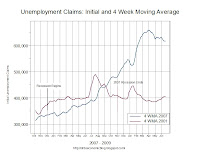
As I have mentioned in previous posts, Robert J. Gordon did research looking at the relationship between the 4 week moving average of initial unemployment claims and found that recessions often bottom out shortly after the 4-week moving average of initial unemployment claims peaks. The average may have peaked at 658,750 for the week ended April 4, 2009. On June 26, 2009 the Department of Labor released the most recent data on initial unemployment claims for the week ended June 20, 2009 in "Unemployment Insurance Weekly Claims Report." Seasonally adjusted initial claims was 627,000, up 15,000 from a revised estimate of initial claims of 612,000 for the week ended June 13, 2009. The 4 Week moving average increased 500 to 617,250. The average is down 41,500 from its peak, signaling a possible peak for this business cycle. Even though the average has declined, initial claims are still very high.

Using National Bureau of Economic Research estimates on the beginning and ending dates of recessions, I have also included a graph that compares the recession that began in March 2001 with the current recession which began in December 2007. Both graphs are measured over 92 weeks, beginning eight weeks before the recessions began. The horizontal axes begins in October 2007, and the data for the 2001 recession is superimposed on those dates. The graph gives some insight into why economists, politicians and others have expressed so much concern about the current recession. As time permits, I will add data from other recessions to the graph.

Replace this text with...


Read more!

Tuesday, May 26, 2009

Unemployed Retiring to Collect Social Security

Many Social Security eligible unemployed are retiring early and drawing reduced benefits rather than rebuilding their retirement accounts.  From Mike Dorning of the Los Angeles Times, "Early retirement claims increase dramatically," May 24, 2009. 
Reporting from Washington -- Instead of seeing older workers staying on the job longer as the economy has worsened, the Social Security system is reporting a major surge in early retirement claims that could have implications for the financial security of millions of baby boomers.

Since the current federal fiscal year began Oct. 1, claims have been running 25% ahead of last year, compared with the 15% increase that had been projected as the post-World War II generation reaches eligibility for early retirement, according to Stephen C. Goss, chief actuary for the Social Security Administration.

Many of the additional retirements are probably laid-off workers who are claiming Social Security early, despite reduced benefits, because they are under immediate financial pressure, Goss and other analysts believe.

The numbers upend expectations that older Americans who sustained financial losses in the recession would work longer to rebuild their nest eggs. In a December poll sponsored by CareerBuilder, 60% of workers older than 60 said they planned to postpone retirement.

Read more!

Wednesday, March 4, 2009

Barro And The Probability Of A Depression

"What Are the Odds of a Depression?," an article written by Robert Barro, and published in today's Wall Street Journal is making the blog rounds today (HT Greg Mankiw, and RealClearMarkets). I like the article for many reasons, two of which I will name.

He gathers data to answer a question or hypothesis, and I like his data.

We also {in addition to U.S. data] assembled long-term data on GDP, consumption and stock-market returns for 33 other countries, sometimes going back as far as 1870. Our conjecture was that depressions would be closely connected to stock-market crashes (at least in the sense that a crash would signal a substantially increased chance of a depression).

Barro provides statistically generated information about a current problem of great interest, the probability of the U.S. falling into a depression, defined as a fall of at least 10% of GDP.

In the end, we learned two things. Periods without stock-market crashes are very safe, in the sense that depressions are extremely unlikely. However, periods experiencing stock-market crashes, such as 2008-09 in the U.S., represent a serious threat. The odds are roughly one-in-five that the current recession will snowball into the macroeconomic decline of 10% or more that is the hallmark of a depression.

The bright side of a 20% depression probability is the 80% chance of avoiding a depression. The U.S. had stock-market crashes in 2000-02 (by 42%) and 1973-74 (49%) and, in each case, experienced only mild recessions. Hence, if we are lucky, the current downturn will also be moderate, though likely worse than the other U.S. post-World War II recessions, including 1982.


Read more!

Sunday, February 15, 2009

Europe Is Hurting Too

(HT Drudge) Eric Pfanner of the International Herald Tribune in "Europe's economic slump deeper than expected," writes

Europe sank even deeper into recession than the United States in the closing months of last year, according to figures published Friday, as finance ministers of leading industrialized nations gathered in one of the worst-affected countries, Italy, for discussions on the crisis.

In the fourth quarter, the economy of the countries sharing the euro declined by 1.5 percent, according to the European Union's statistics office. That is even worse than the 1 percent decline in the U.S. economy during that period, compared with the previous quarter.

"Today's data wipes out any illusion that the euro zone is getting off lightly in this global downturn," said Jörg Radeke, an economist at the Center for Economics and Business Research in London.


Read more!