In one of my first posts, I criticized Paul Krugman and George Will over their description of depression era economic policy and its effectiveness. Although I believe my reading of the economic literature is correct, I wish I had offered my opinion as another hypothesis of events that had some empirical support.
I also disagree with their assessment that WWII was a great public works program that ended the Great Depression. After reviewing a few sources, I am less sure that the opinion I will offer is the majority opinion, but I believe that it is correct.
War is never good for an economy. It may be the least bad alternative or it may be the morally right action, but it is never good for the economy. I am not only worried about an incorrect interpretation of WWII, but the implication that if war can be good for the economy once, then it might be good again.
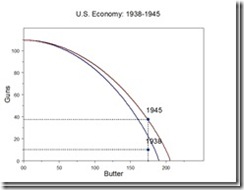
Those who argue the economic virtues of WWII generally point to two apparent economic accomplishments of the war: unemployment fell and gross domestic product grew. The graph, "U.S. Economy: 1938-1945", a nostalgic "guns and butter" graph for those of us who studied economics during the Vietnam War, illustrates this position. This graph has made up numbers and breaks down production into two goods, guns representing armaments, and butter representing consumer goods. In 1938, the nation was in the interior of the frontier. As the war progressed, unemployment fell, and production increased. We ended up at a point labeled 1945. The expansion of the production frontier from the blue line to the red line represents economic growth.
Why is this analysis flawed? Value in exchange occurs only when it is voluntary. When another country threatens our physical safety, or our way of life, we have been denied our freedom to select the mix of guns and butter that we desire. We do not build armaments or go to war because we enjoy it, but because we must. I hope that I am correctly stating American values.
Unemployment did decrease during the war. In 1939 between 7 and 8 million workers were unemployed. In part that was accomplished by drafting a big chunk of our labor force. By the ended of the war, approximately 12 million men were in uniform. I doubt that hundreds of thousands of the newly unemployed are lining up at recruiters offices. They apparently value their unemployed civilian activities more than their potential employed military activities.
War is also tough on resources. Output did increase as illustrated on the graph, but those resources were used to make goods that are only desirable if we are threatened, tanks, artillery, bombers, etc. Furthermore, use of these resources generally leads to their destruction. They might add to GDP, but they add little to national wealth. We have also failed to mention what I believe to be the biggest loss, about 400,000 dead and 1,000,000 injured.
Growth in our economy should be measured by the increase in the value of goods and services we wish to consume. The production of consumer goods did not grow during the war, and a large number of those goods were rationed. Because we could not purchase goods that we wished to consume and we were compelled to produce goods we did not wish to produce, it could be argued that the price mechanism was not functioning and GNP was improperly measured.
Three conditions must be met to conclude that war is good for the economy. It must be fought in foreign lands, must be won, and a low value must be placed on American dead. Unemployment is growing and production is declining. Certainly we could find a war that meets the first two conditions, and if we are careful, we could minimize American deaths. Should we reinstitute the draft and expand the War on Terrorism as part of a stimulus package?
Read more!


 Posts
Posts


